Set continuity for Makeup · Hair · Wardrobe · MUFX
Continuity, script breakdowns, looks, kit, expenses and timecards for the departments that make the look — offline-first, in eight languages, built by working IATSE crew.
In daily use on a network one-hour drama. Free for artists — live on Google Play, iPhone beta via TestFlight. Productions request a licence for the whole crew.
Put your show on the distro and the paperwork files itself. Times stamp from the chair. Timecards land on the payroll company's own forms.
Photos label themselves as you shoot. Compare two takes side by side, carry holds across scenes, and hand production the whole book at wrap.
Parkades, forests, stages with no signal — offline first, sync later. No service at all? The trailer's own Local Net carries the chat phone-to-phone.
One book, every chair
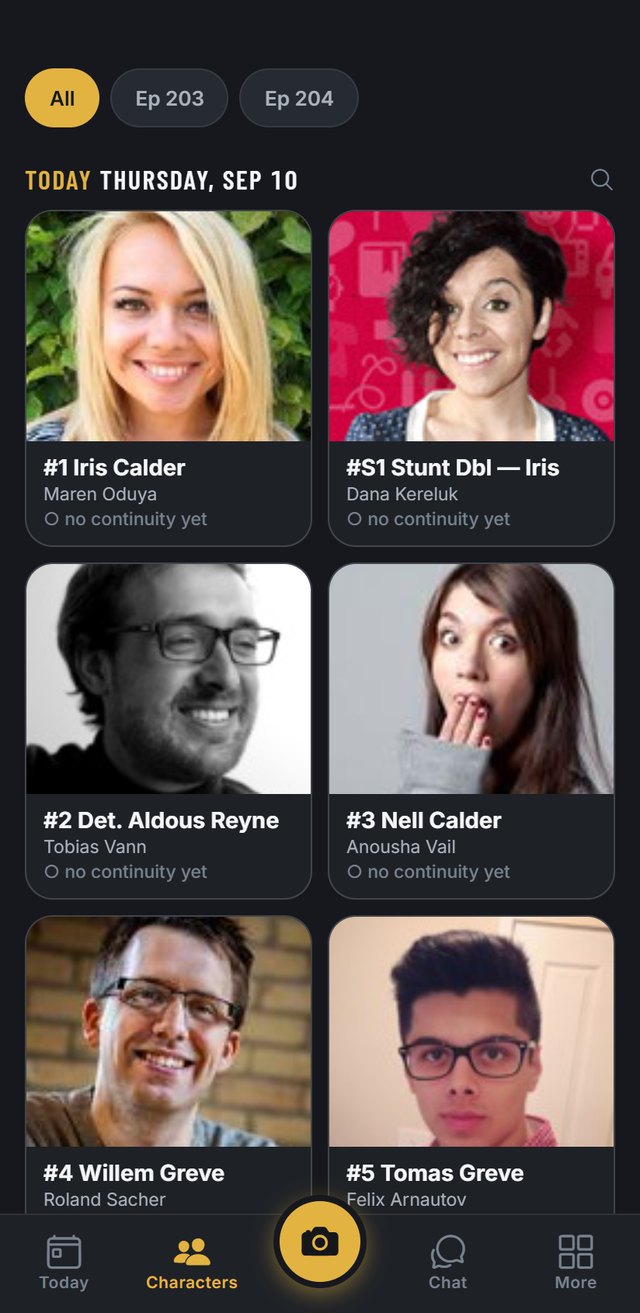
The look you set this morning, still matchable when the pickup lands months later — photographed and labeled at the chair, not rebuilt from memory. Face charts drawn with your real product shades, layered and versioned. Product records, notes and reference photos all live on the character.
The style that has to match last Tuesday — photographed, labeled, findable in two taps. Wig and piece notes on every character, the day's chair plan by the week, and the same one-tap timecards as the room next door.
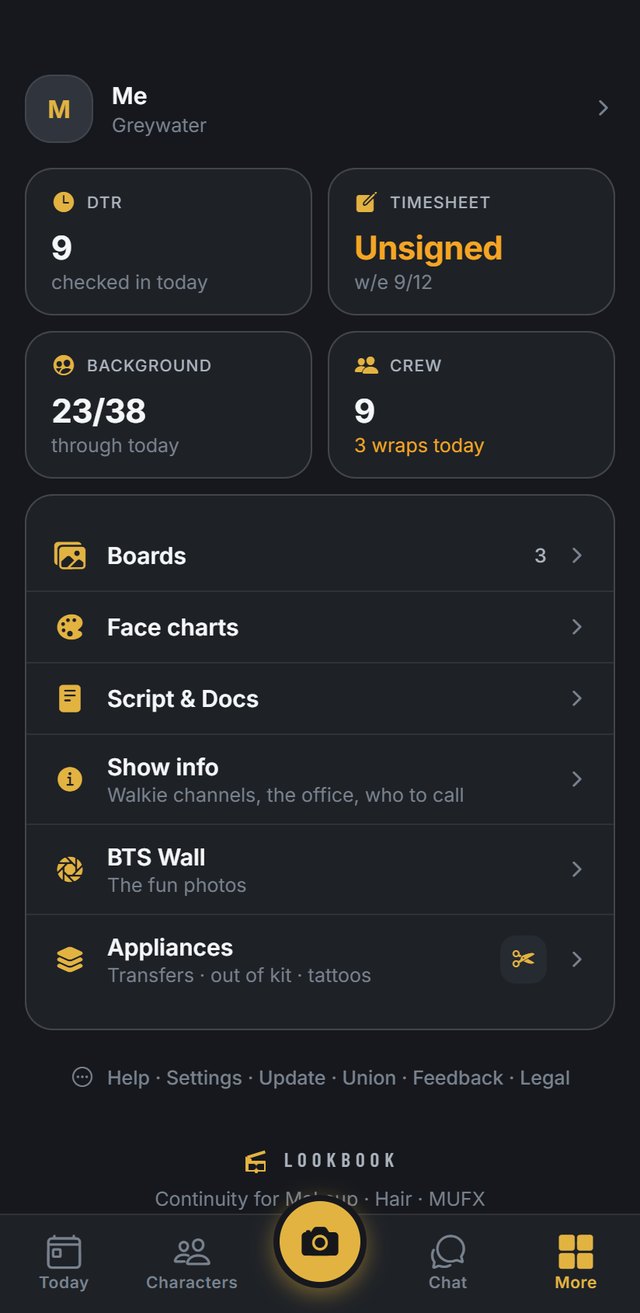
Appliances tracked from lifecast through mold, run and set count — and the makeup room's own pieces, transfers, tattoos and out-of-kit, on the same bench. Creature stages carried as looks per character, so episode 7 matches episode 2 even with a different artist in the chair.
Rolling out next. The continuity book already does the core job — the jacket photographed on Tuesday is findable on Friday — and dedicated wardrobe tools are on the roadmap. Costumers: we'd love your input while it's being built.
Every character carries their looks, their continuity record, and their story-day progression — the healing bruise, the lace-front that has to match, the re-worn jacket, the creature stages.
Everything a department carries in binders, clipboards and camera rolls, in one app that works with no signal.
Script & sides
The script comes in off the distro, or you upload it yourself. Either way it comes back as scenes — the full text, who's in each one, and what your department has to do. An 80-page script starts showing scenes in seconds and keeps loading while you read.
Makeup, hair and MUFX are broken out separately — blood and bruises on one list, wigs and wet-downs on another, appliances on the third. The lines each note came from are highlighted on the script page, and anything the read missed you add with a long press.
Every character keeps the same voice for the whole script, and the delivery follows the page — a line written as a whisper is whispered. For the drive in, or the end of a fourteen when your eyes are done. Keeps playing with the phone in your pocket.
When the blue pages land, the app compares them to the draft you already read and tells you which scenes moved — and which of those you had work on. Notes sit on scene numbers, so a revision carries them along instead of losing them.
“When does the burn scar first show?” comes back with the scene numbers, so you can go straight there. And the whole breakdown prints as department paper for the key or the trailer wall.
How a day runs on Lookbook
Lookbook runs the trailer side's entire day: the office's paperwork files itself off the distro; continuity photos come out of the camera already labeled; one tap in the chair becomes the official payroll timecard. Fully offline — the phone is the source of truth — and the whole crew stays in sync when signal returns.
You never label another photo again — burst-capture continuity shots come with the label already burned on. Print 4×6s to the trailer printer or share a labeled PDF. Tags like “soot level 2” become findable instead of buried in a camera roll.
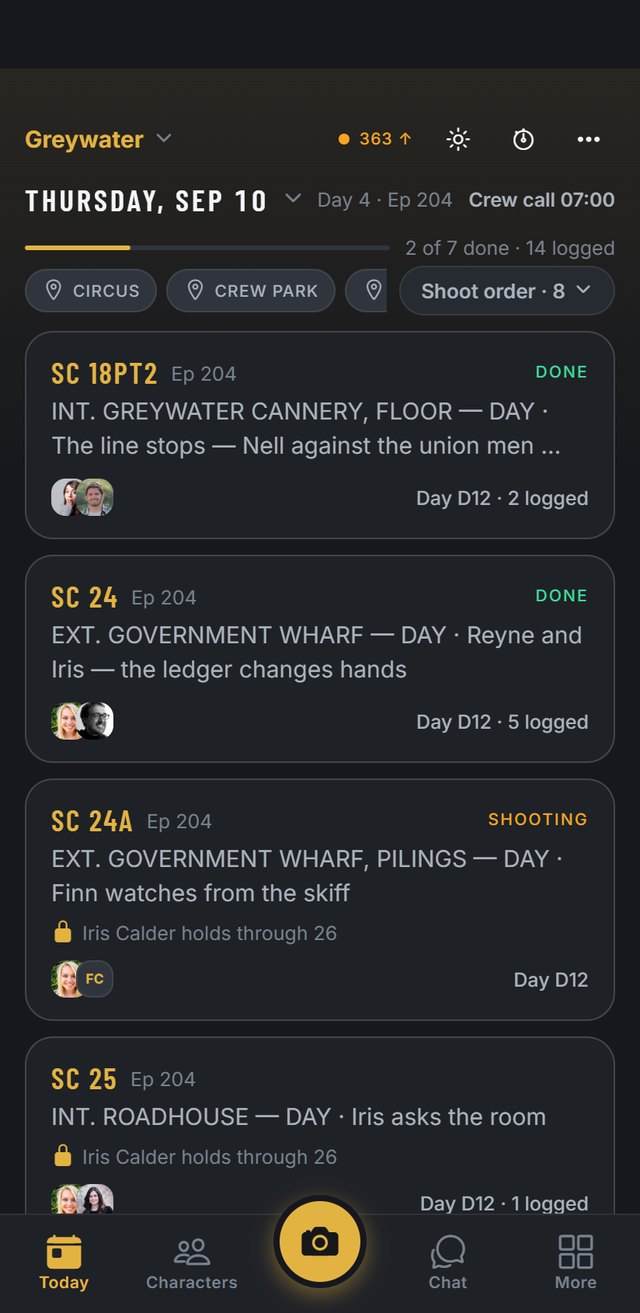
Your show gets its own address. Whatever the office sends — call sheet, sides, script, one-liner, chrono, shooting schedule, DOOD, background breakdown — lands sorted and read, with a push when it does. The sheet brings the full cast table with department and set calls, background counts, locations and notes; arrival alarms follow, and each artist's morning — call, chair, drive, where to park — is one row on Today, with a morning alarm.
Scenes, cast, and the work your chair has to do — each department its own list. Revisions get compared to the last draft so you know what moved, and it'll read the whole thing out loud in cast voices. More →
A tally built for the tent line. The wrangler's list is one document for the whole day — photograph it, or have it emailed in off a QR — and it lands split at its own headings, role by role. One tap per performer through the chair, numbered reference photos, big groups shot a few at a time and counted by heads, the re-shoot after the dirt goes on filed to the same number, and a printable numbered record of everyone.
Chair in/out feeds the daily time report. Weekly timecards fill the payroll company's own official PDF forms — mapped by real weekday, signed on-screen, locked once signed.
Snap the receipt and the line writes itself. Petty cash floated and closed out, P-card and PO lines kept apart, every expense against the department budget — and the wrap report already adds up.
Crew chat with continuity-labeled photo sharing, polls and voice notes — sealed end to end, and with no service at all one phone hosts the trailer's Local Net and the chat hops phone-to-phone. Reference boards for the look of the day. A manpower calendar with day-call bookings artists accept from their phone.
Everything works with zero signal. The phone is the source of truth; the cloud is a mirror. No connection at all? Hand the day to a teammate phone-to-phone. When signal returns, everything syncs. Wrap is shared: the day closes for the whole crew when it's called, and each artist wraps themselves out on their own time.
English, French, Italian, Spanish, German, Portuguese, Japanese and Chinese. The language is the artist's own; the show's paper stays exactly as the office sent it.
Draw with real product shades on a chart fitted to your actor's actual face. Layers, labels, numbered product pins, versioned history. Print it, share it, keep it forever.
At wrap, export the complete continuity book — profiles, looks, product records, per-scene entries and photos — as a deliverable the production keeps.
Per-production access control enforced in the database, private deals and calendars, automatic access expiry for day players, and full account deletion. Read the security overview →
For artists
Productions pay for the show; artists never do. The part of Lookbook that is yours stays with you after wrap, show after show.
Your name, departments, union cards and availability on one card — the thing a key checks before the day-call goes out. Tap it to share.
Every show you work stamps a credit as you work it. The credit sheet prints as a PDF, and the résumé writes itself from it.
One availability calendar across every show. Day-call offers land on your phone and you accept from the chair. Held days and booked days are yours to see; your rate is on nobody else's screen.
The shots you're proud of, released to your portfolio when the show says so. Behind-the-scenes and your face charts stay with you after wrap.
For producers & UPMs
Continuity is photographed and labeled at the chair, the moment it exists — not reconstructed from memory when the pickup gets scheduled. Matching errors are reshoots; reshoots are money.
The Wrap Archive — the production's complete continuity book: looks, product records, per-scene entries and photos — exported and owned by the show. The binder, but it can't be left in a trailer.
DPA ready, security overview written for your reviewers, NDAs executed on request. Production data is isolated per show, and crew chat stays with the crew.
Crew joins with an invite code in under a minute. Day players' access expires automatically after their last day. No accounts to administer, no seats to count, nothing to install on your side.
For productions
A department head champions it; the production licenses it for the run of the show; every artist — keys, dailies, day players — joins free. Licences are tailored to the show's size and schedule.
How licensing works